I received the following request for advice from a reader last week and decided to post it here for you all to give your opinion on. I have also included my advice for two reasons… 1. because you might find in helpful. and… 2. Â my return email to this reader kept bouncing back to me so I was unable to help offline.
Here is what she wrote~
“…Laundry is my groundhog day & it’s really doing my & my husbands head in…. We have an 11 & 7 year old & I am sure that sometimes things go in the laundry basket rather than be put away – there are times I know I an rewashing clean clothes – but after a couple of days in the basket they have associated smells & so in they go…
I have started to think the only way, (which you might approve of) is to declutter the volume of clothes & options they have….. Do you have tips of what you did when your kids were young…
I have taught my daughter where the washing machine is & how it works but from her point of view I am sure she feels that she has no use for this information ! well not yet anyway… As working parents it’s overwhelming the sheer volume of washing that we are doing, & then once washing is done getting it folded & back to where it belongs is grinding. Any thoughts…. Is the answer always declutter ? Or can you help me out with this too. ps: I did think about putting a second tub in their room that’s the “it’s clean but I just couldn’t be bothered to put it away” tub – maybe, maybe……”
And her is my response ~
I think that you have answered your own question. It seems to me, from observation and experience, that people take possessions for granted the more of them they have. If, for example, there is always another outfit to put on when one hasn’t rehung or even used the last one that went in the wash then what incentive is there to be more mindful.
That being said, kids grow out of their clothes soon enough so maybe decluttering yours would be a waste of money unless they have clothes in their closets that are too small. Those I would get rid of immediately.
However from this point forward, as they grow into the next size, my suggestion is to reduce the number of outfits you supply them. On the lead up to this you can use the time to sit both of your children down and explain to them that they are going to have to be more thoughtful with their clothes in future because they are going to have fewer of them. Explain to them why this is without blaming, after all kids deserve an explanation and it may result in them being more willing to comply. Provide them with a system for hanging the things they can wear again, such as a small coat rack or a series of hooks. Explain to them that if they continue to wear things once or not at all and just toss it in the wash then they may run out of clothes to wear before the next wash day comes around (which will be less often than it does now).
The time it will take for their current clothes to dwindle, due to them growing out of them, will give you all time to adjust to the new routine. Your mission is to resist slaving in the laundry trying to keep up with them. Don’t pander to their desire to have whatever they want clean and ready for them at all times by constantly washing to keep up. They will soon learn that life just doesn’t work that way any more. Train them and remind them on a regular basis to wear, more than once, the clothes that aren’t visibly soiled or smelly. Underpants of course the exception to this rule.
You asked how I handled this with my kids and I would say that what I have written above just about covers it. They weren’t over supplied with clothes and they both had a little clothes rack to hang the items they could wear again. Admittedly they often hung their clothes on the floor under the clothes rack but kids will be kids. I must also admit that I probably trained them too well to reuse clothes because I often had to (and still do have to at times) remind them that some items have been worn long enough.

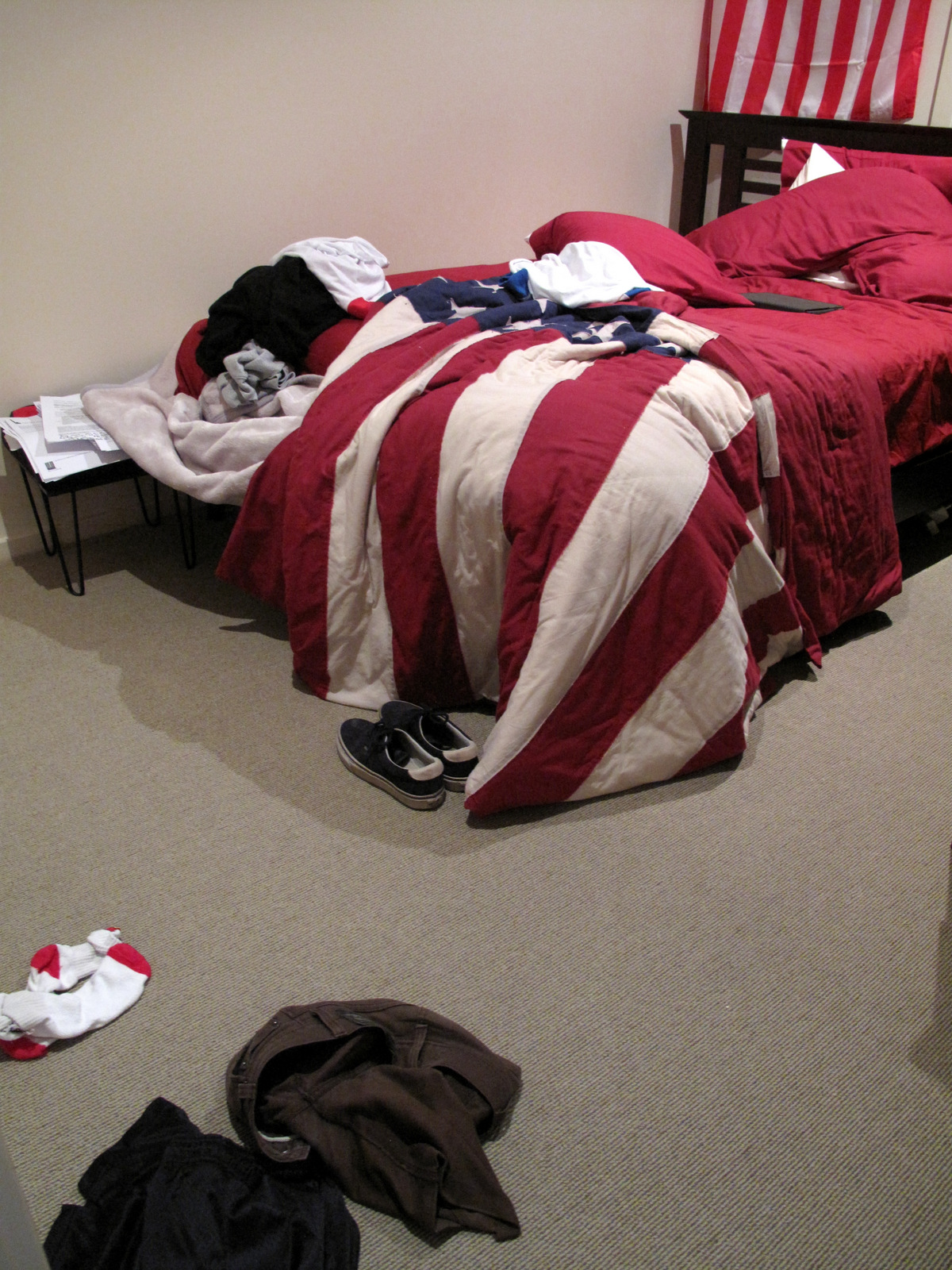
My son’s less than tidy room.
My son is the only one home now and he still has a habit of leaving his worn clothes on the floor until he is ready for them to be washed. If he is around on wash day I do ask him to toss, into the hall, what he wants washed. If he isn’t home I will make an executive decision. In a bid to save on water and electricity I only wash when I have a full load (black, white & lights, colours or neutrals). Â However if specific items aren’t available when he wants to wear them then it is just too bad because washing individual items is simply out of the question.
Parenting isn’t an exact science and, as you can see from the photo on the right, I have not been successful in the long term at training my son to keep his room tidy or make his bed. The kids complied under duress when younger but once they reached a certain age I decided it wasn’t worth the continued grief. His is however the only untidy room in the house and the only time his bed is made is when I change his sheets but I can always close the door. I refuse however to behave as though I am running a laundry so it is either comply or go without.
The Weekend’s Mini Missions
Saturday –  Declutter some old cleaning rags that have been used too many times already. Perhaps you could repurpose some of those linen items mentioned above into new rags. Personally I use microfibre and some of mine are getting very thread bare and therefore ineffective so will be tossed this week.
Sunday - Sunday is reserved for contemplating one particular item, of your choice that is proving difficult for you to declutter. Whether that be for sentimental reasons, practical reasons, because the task is laborious or simply unpleasant, or because the items removal requires the cooperation of another person. That last category may mean that the item belongs to someone else who has to give their approval, it could also mean there is a joint decision to be made or it could mean that the task of removing it requires assistance from someone else. There is no need to act on this contemplation immediately, it is more about formulating a plan to act upon or simply making a decision one way or another.
“In daily life we must see that it is not happiness that makes us grateful, but gratefulness that makes us happy.” Brother David Steindl-Rast




 Subscribe by RSS